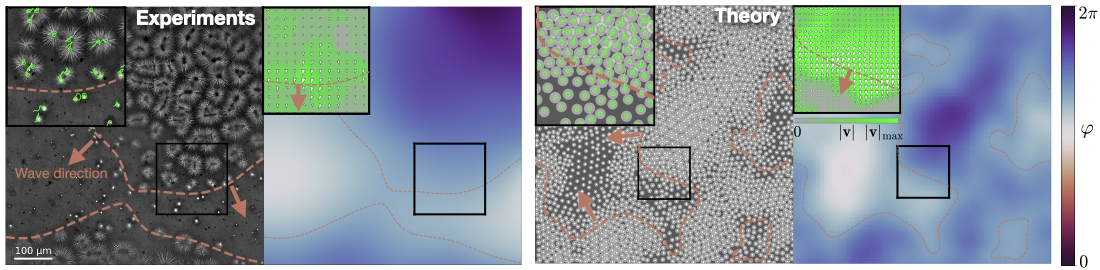
How chemical waves in a cell extract create their own currents
Early embryos rely on rhythmic biochemical “waves” sweeping through the cytoplasm to coordinate cell division. We found that these waves don’t just pass through passively — they physically drag material along with them, creating coherent flows. We built a simple model of growing, wave-synchronized particles that reproduces this coupling, and showed that when the mechanical push is strong enough, it can even help different parts of the cell-like extract fall into sync with each other.
Collaborators: Elissavet Sandaltzopoulou, Jan Brugués, Frank Jülicher
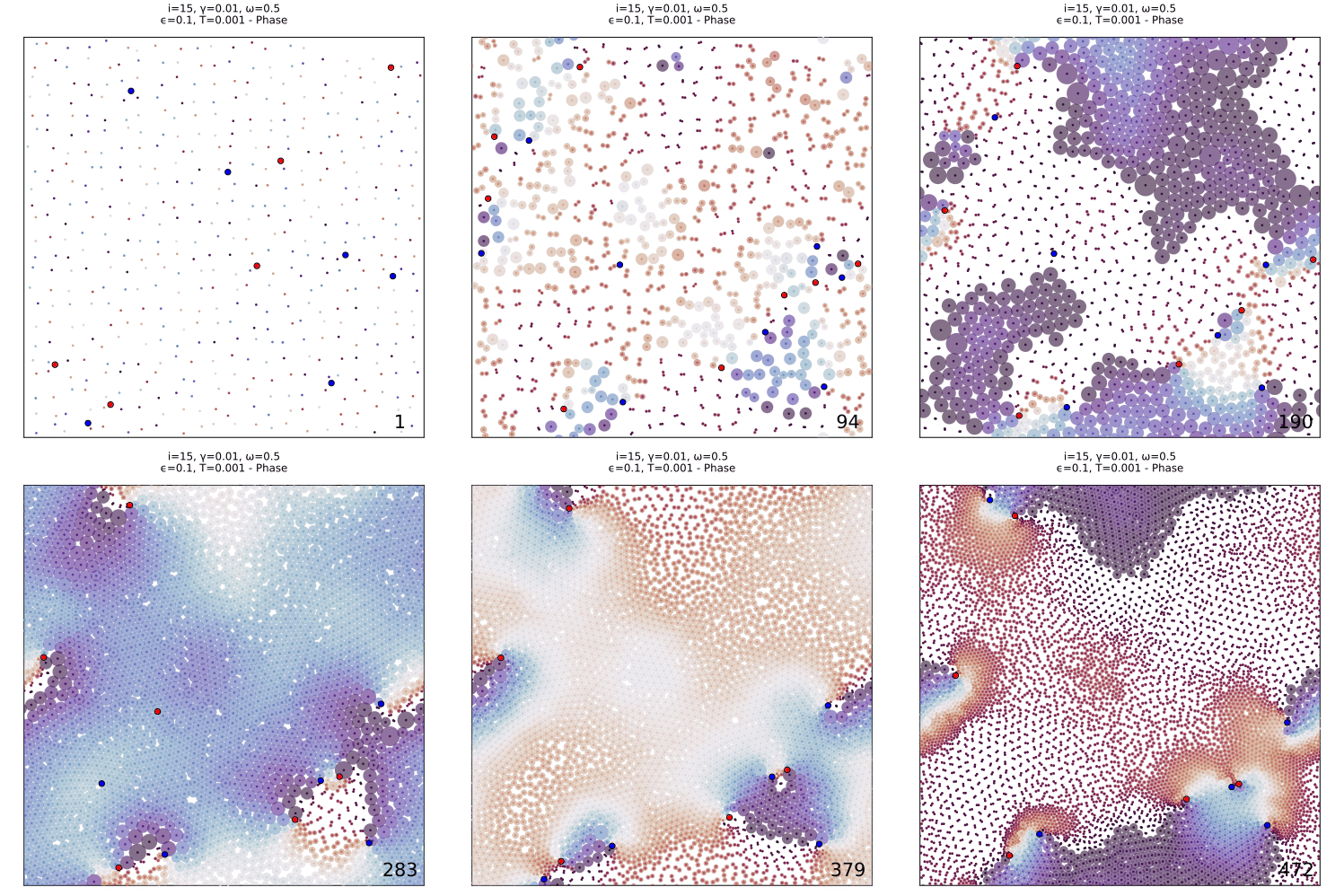
How cell division keeps a tissue's rhythm from settling into total order
In systems where units divide (embryos, tissues, bacterial colonies), you’d expect chemical rhythms to either sync up perfectly or fall apart into chaos. We found a third option: division actively maintains small, stable pockets of disorder (“phase defects”) that would otherwise disappear over time. This gives a simple, physical explanation for why these systems keep a certain amount of built-in messiness instead of becoming perfectly regular — and it depends entirely on how synchronized things were to begin with.
Collaborators: Saul Ruano, Jan Brugués
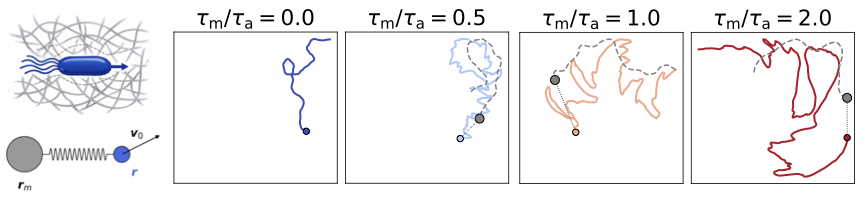
Does an environment's memory help or hurt swarming active particles?
Most models of self-propelled particles — like the ones used to describe swarming bacteria or synthetic microswimmers — assume the fluid around them responds instantly to their motion. Real environments are rarely that simple: many are viscoelastic, meaning they “remember” how they were pushed a moment ago and respond with a delay. We buily a minimal model of active particles moving through such a memory-carrying environment, and found that this delay can completely change whether the particles clump together or stay spread out. When the environment’s memory lasts about as long as the particles’ own persistence, the delayed pushback actually works against them, suppressing clustering and making clumps form much more slowly. But if the memory lingers even longer, it has the opposite effect: it reduces friction just enough to give the particles an effective speed boost and bring the clustering back.
Collaborators: Ivan Di Terlizzi, Jack Treado
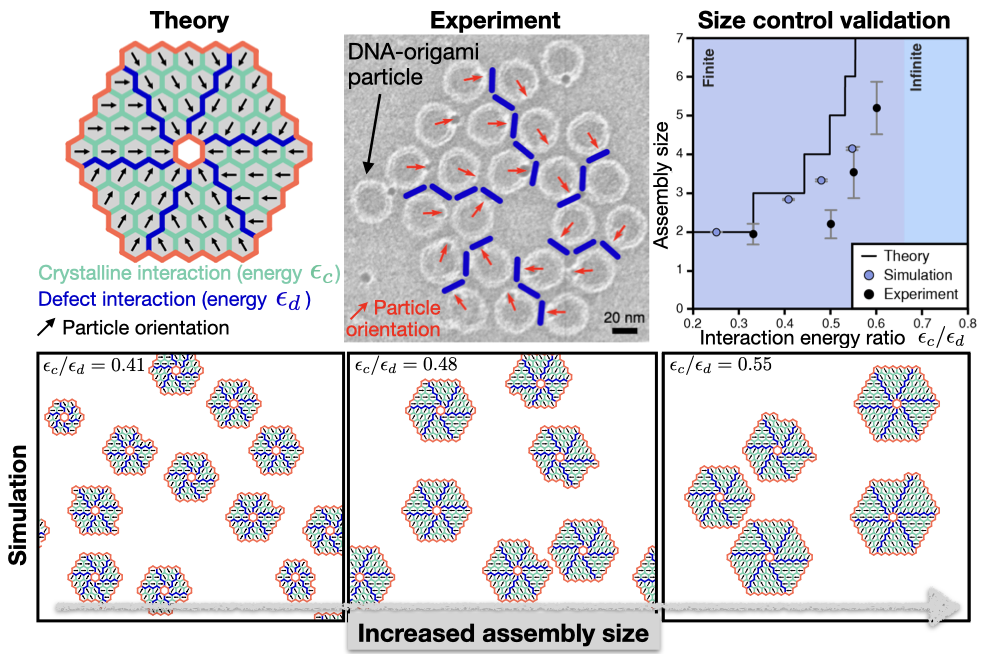
Engineering defects to build self-limiting nanostructures
For applications like drug delivery, you often want particles that self-assemble into structures of a specific, controlled size — not ever-growing crystals. Instead of trying to avoid defects, we designed particles that actively want to form them, and showed that competition between “grow” and “make a defect” naturally caps the structure at a tunable size. We tested the idea for real using DNA origami particles built by our collaborators, and the experiments matched the theory closely.
Collaborators: Markus Eder, Vincent Ouazan-Reboul, Christoph Karfusehr, Andrey Zelenskiy, Pierre Ronceray, Friedrich Simmel, Martin Lenz
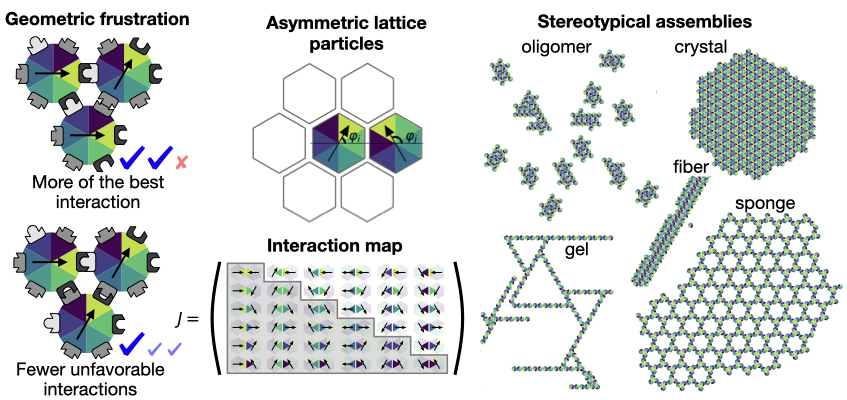
Why do proteins and colloids only ever form a few shapes?
Even though the ingredients of self-assembly can be incredibly varied — different amino acids, different colloid coatings — the end results tend to fall into just a handful of familiar shapes: fibers, crystals, gels, blobs. We built a simplified model of particles that interact only through the faces they touch, then let a computer explore millions of possible interaction rules. The surprise: almost all of that variety collapses into the same small set of structures, and we could pin down why — it comes down to how much the particles’ preferences clash with each other (geometric frustration).
Collaborators: Pierre Ronceray, Martin Lenz